Selling a home in Florida can feel like a big win, especially if your property has gone up in value. But before you get too excited about the profits, it’s important to think about capital gains tax Florida and how it might affect your earnings. While Florida doesn’t have a state capital gains tax, federal taxes still apply, and knowing the rules can help you keep more of your money.
Let’s explore how capital gains taxes work, what makes Florida unique, and why selling your home to Golex Properties can help you save time, stress, and money.
Florida Capital Gains Tax: Everything You Need to Know
If you’re planning to sell a property in Florida, you’ve likely heard about capital gains tax. While Florida doesn’t have its own state capital gains tax, federal taxes still apply—and understanding these can help you keep more of your profits. Let’s break down what capital gains tax is, how it affects homeowners in Florida, and what you can do to minimize your tax burden.
What Are Capital Gains Taxes?
When you sell something for more than you paid for it, the profit you make is called a “capital gain.” The IRS charges a tax on that gain, which is known as capital gains tax. For real estate, this tax comes into play when you sell a home or investment property that’s appreciated in value.
In Florida, things are a bit different. The state doesn’t have its own capital gains tax, but you still have to pay federal taxes on your profits. Knowing how these taxes work is key to making smart decisions when selling your property.
Does Florida Have a Capital Gains Tax?
Here’s the great news: Florida doesn’t have a state income tax, so there’s no separate Florida capital gains tax. This makes Florida a tax-friendly state for homeowners and real estate investors. However, federal capital gains taxes still apply, so you’ll want to understand those rules before selling your property.
What Is Capital Gains Tax, and How Does It Work?
Capital gains tax is a federal tax you pay on the profit you make when selling an asset, like a house or an investment property. The amount you owe depends on two key factors:
- How long you owned the property.
- Your income level.
Federal Capital Gains Tax Rates
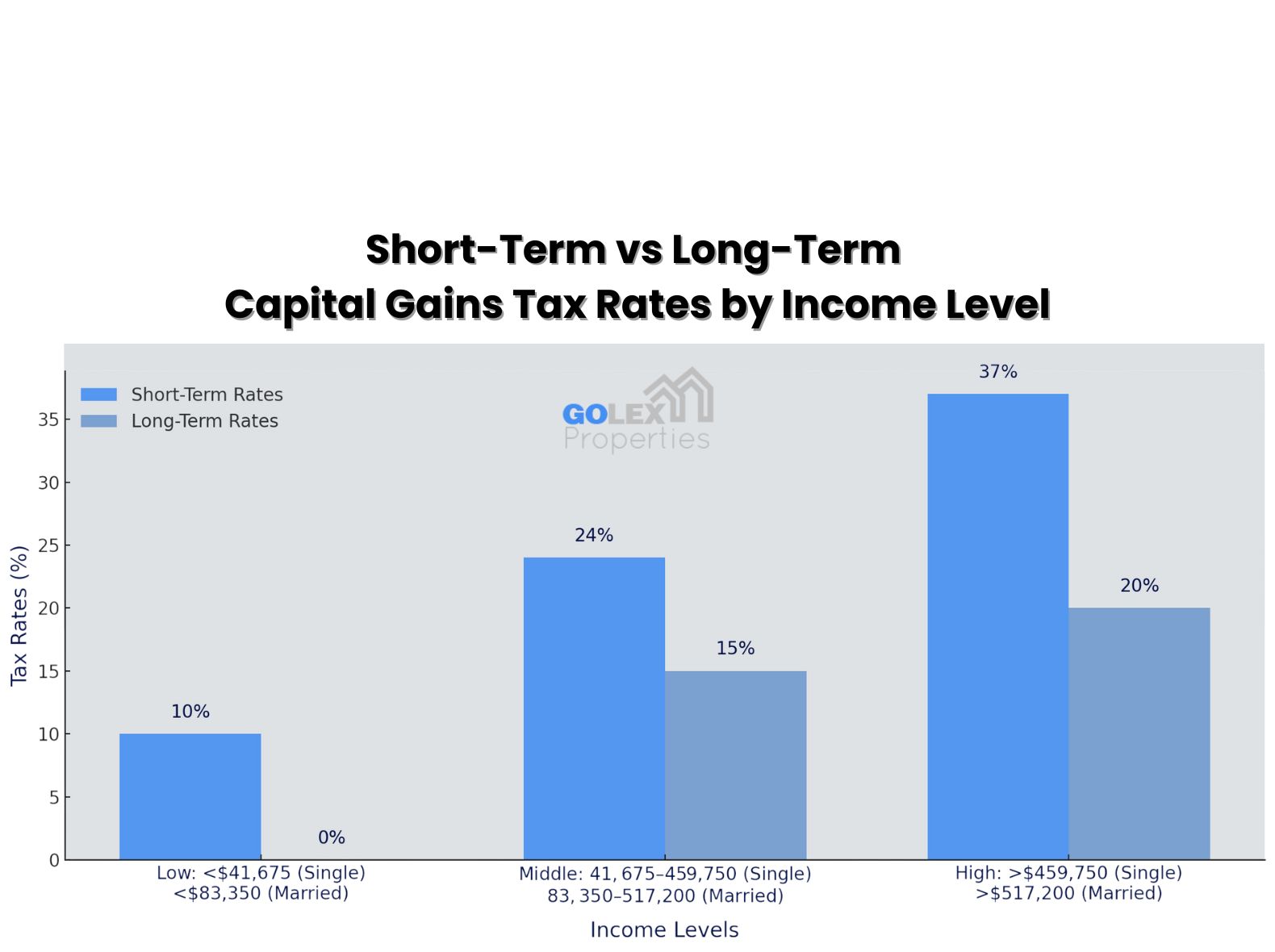
Short-Term Capital Gains
- Applies if you’ve owned the property for less than one year.
- Taxed as ordinary income, with rates ranging from 10% to 37%, depending on your income level.
Long-Term Capital Gains
- Applies if you’ve owned the property for more than one year.
- Taxed at lower rates:
- 0% for lower-income earners.
- 15% for middle-income earners.
- 20% for higher-income earners.
How Does Capital Gains Tax Impact Florida Homeowners?
The good news is that many Florida homeowners can reduce or even avoid federal capital gains tax altogether, especially if the property being sold is their primary residence. For investment properties, however, the rules are a bit stricter.
Primary Residence Exemption
The IRS allows homeowners to exclude some or all of their capital gains from federal taxes when selling their primary residence.
- Single filers: Can exclude up to $250,000 of profit.
- Married couples filing jointly: Can exclude up to $500,000 of profit.
To qualify for this exemption, you must meet these conditions:
- You’ve owned the property for at least two years.
- You’ve lived in the property as your primary residence for at least two of the last five years.
- You haven’t claimed this exemption on another property in the past two years.
What If I Don’t Meet These Requirements?
If you’ve lived in your home for less than two years, you might not qualify for the full exemption. However, partial exemptions may be available if your move was due to work, health, or other unforeseen circumstances.
What About Investment Properties?
For rental properties, vacation homes, or other investment properties, the rules are different:
- No primary residence exemption: You’ll likely pay capital gains tax on the entire profit from the sale.
- Depreciation recapture: If you’ve claimed depreciation deductions while owning the property, you’ll also owe taxes on those deductions when you sell.
Example:
If you bought a rental property for $200,000 and sold it for $300,000, the $100,000 profit is taxable as a capital gain. If you claimed $20,000 in depreciation over the years, you’d owe additional taxes on that $20,000.
How Can You Minimize Capital Gains Taxes?
Here are a few strategies to reduce your federal tax liability:
- Keep Detailed Records of Expenses:
Document renovations, repairs, and closing costs. These can increase your property’s cost basis, reducing your taxable profit. - Use a 1031 Exchange:
If you’re selling an investment property, you can defer capital gains taxes by reinvesting the proceeds into another similar property using a 1031 exchange. - Sell Smart with Golex Properties:
Golex Properties makes selling hassle-free, offering a quick sale with no hidden fees, which helps you avoid additional costs that could eat into your profits.
Why Selling to Golex Properties Can Save You Money
Golex Properties specializes in helping Florida homeowners sell quickly and easily, even in tricky situations. Here’s how selling to Golex can make a difference:
- Fast Closings: We can close in as little as a week, which helps you avoid holding costs like property taxes and utilities.
- No Repairs Needed: We buy homes “AS IS”, so you don’t need to spend money fixing up your property before selling.
- No Hidden Fees or Commissions: Traditional real estate agents charge commissions, but with Golex, what we offer is what you get.
- Tenant-Friendly Sales: If you’re selling a rental property with tenants, we’ll take care of the transition so you don’t have to.
Frequently Asked Questions About Capital Gains Tax in Florida
Q: Do I owe capital gains tax if I sell my house for less than I paid for it?
A: No. If you sell your home for less than your purchase price, you won’t owe capital gains tax. However, you also can’t deduct the loss from your taxes unless it’s an investment property.
Q: Can I avoid capital gains tax if I reinvest the money?
A: For investment properties, yes—you can use a 1031 exchange to defer taxes by reinvesting in another property. For primary residences, reinvestment doesn’t provide the same benefit.
Q: How does Golex Properties help with capital gains taxes?
A: While we don’t provide tax advice, selling to Golex can simplify the process by offering fast closings and eliminating repair or commission costs, which can help maximize your profits.
How Much Capital Gains Tax Will I Pay in Florida?
The amount of capital gains tax you’ll pay depends on two main factors:
- How long you’ve owned the property.
- Short-term gains (if owned for less than a year): Taxed at your regular income tax rate, which ranges from 10% to 37%, depending on your federal tax bracket.
- Long-term gains (if owned for more than a year): Taxed at lower rates:
- 0% for lower-income earners.
- 15% for middle-income earners.
- 20% for higher-income earners.
- Your income level.
Your federal income tax bracket determines the rate for long-term capital gains.
Key Point: Florida doesn’t have a state income tax, so there’s no additional Florida capital gains tax on top of what you owe federally.
Example Calculation:
- You bought a home for $200,000 and sold it for $300,000, making a $100,000 profit.
- If you qualify for the long-term rate and are in the 15% bracket, you’d pay $15,000 in federal capital gains tax.
Do I Have to Pay Capital Gains Tax When I Sell My House in Florida?
It depends on the type of property and whether you qualify for any exemptions.
Primary Residence
If the property you’re selling is your primary residence, you may not have to pay capital gains tax at all, thanks to the IRS’s Primary Residence Exemption:
- Single filers can exclude up to $250,000 of profit.
- Married couples filing jointly can exclude up to $500,000 of profit.
To qualify for this exemption, you must:
- Have owned the property for at least two years.
- Have lived in the property as your primary residence for at least two of the last five years.
- Not have claimed this exemption on another property in the past two years.
FAQ: What if I don’t meet the two-year requirement?
You might still qualify for a partial exemption if you’re selling due to work relocation, health reasons, or other unforeseen circumstances.
Investment or Vacation Properties
If you’re selling an investment property or second home, you won’t qualify for the primary residence exemption, and you’ll likely owe capital gains tax on the entire profit.
Depreciation Recapture:
If you’ve taken depreciation deductions on an investment property, you’ll owe taxes on those deductions, too, when you sell.
How Can I Avoid Paying Capital Gains Tax in Florida?
While you can’t completely avoid federal capital gains taxes in every situation, there are smart strategies to reduce or defer what you owe:
1. Use the Primary Residence Exemption
If the property is your primary home and you meet the requirements, you can exclude up to $250,000 (single) or $500,000 (married) of your profit from federal taxes.
2. Consider a 1031 Exchange for Investment Properties
A 1031 exchange allows you to defer capital gains taxes by reinvesting the proceeds from the sale of an investment property into another similar property.
Requirements for a 1031 Exchange:
- The new property must be “like-kind” (similar in nature or purpose).
- You must identify the new property within 45 days of the sale.
- The exchange must be completed within 180 days.
3. Document Your Costs to Increase Your Cost Basis
Your capital gains are calculated as the difference between the sale price and your property’s “cost basis.” Increasing your cost basis lowers your taxable profit.
You can add the following expenses to your cost basis:
- Renovations or home improvements (e.g., new roof, kitchen upgrades).
- Closing costs from when you bought the property.
- Selling expenses, like agent commissions and advertising fees.
4. Sell to Golex Properties
Selling your property quickly, without repairs or commissions, helps you maximize your profits and avoid unexpected costs that could cut into your gains.
What Is the Capital Gains Tax in Florida for 2024?
As of 2024, Florida still does not have a state income tax, which means there is no separate Florida capital gains tax. You’ll only need to consider federal capital gains tax rates:
- Short-term gains: Taxed as ordinary income (10%–37%).
- Long-term gains: Taxed at lower rates (0%, 15%, or 20%).
Understanding capital gains tax Florida laws is an important step in making the most of your property sale. Whether you’re selling your primary home or an investment property, knowing the rules and taking the right steps can save you a lot of money.
How Selling to Golex Properties Can Help You Save
At Golex Properties, we understand that selling a home in Boca Raton or elsewhere in Florida can be stressful, especially when you’re juggling financial concerns like capital gains taxes. That’s why we offer a simple, hassle-free solution: we buy homes in “AS IS” condition for cash, with fast closings and no hidden fees. Selling to us isn’t just convenient—it can also help you save money in several ways. Let’s break it all down.
The Benefits of Selling to Golex Properties
1. Close Quickly to Avoid Extra Costs
Owning a property comes with ongoing expenses that add up over time, including:
- Property taxes.
- Utility bills.
- Maintenance and repair costs.
The longer you hold onto a property, the more you spend on these recurring costs. With Golex, you don’t have to wait months for a sale. We can close in as little as one week, saving you from paying for those extra months of expenses.
How this helps with capital gains taxes:
Selling quickly ensures you lock in your profits sooner and avoid additional costs that could reduce your financial gains.
2. Skip Repairs and Save Money
When selling through traditional methods, most buyers expect the home to be in good condition. This often means spending thousands on repairs, upgrades, or staging to attract offers.
With Golex, there’s no need to:
- Fix leaky roofs or broken appliances.
- Replace outdated flooring or repaint walls.
- Worry about curb appeal or staging your home.
We buy homes exactly as they are, so you can keep the money you would’ve spent on repairs and focus on your next step.
FAQ: What does “AS IS” really mean?
It means we’ll buy your home no matter its condition—whether it’s move-in ready or needs significant repairs.
3. No Fees or Commissions
Working with a traditional real estate agent usually means paying:
- A 6% commission on the sale price.
- Closing costs, which can be another 2-5%.
These fees add up quickly and take a chunk out of your profits.
When you sell to Golex, there are no:
- Agent commissions.
- Closing costs.
- Hidden fees of any kind.
What we offer is exactly what you’ll walk away with—no surprises.
FAQ: How does Golex determine the offer price?
We base our cash offers on the current market value of your home, considering factors like its condition, location, and comparable sales in the area.
4. Hassle-Free Investment Property Sales
If you’re selling an investment property, things can get complicated—especially if you have tenants living in the home. Managing evictions, lease negotiations, or tenant concerns can be time-consuming and stressful.
With Golex, you don’t have to worry about any of that. We’ll:
- Buy properties with tenants still living in them.
- Handle tenant-related issues after the sale.
This makes selling an investment property fast, easy, and worry-free.
FAQ: What happens to the tenants after I sell?
Once we purchase the property, we take over all responsibilities as the new owner. This includes communicating with tenants and managing leases.
Tips to Reduce Your Capital Gains Tax Liability
Even though there’s no Florida capital gains tax, federal taxes can still impact your profits. Here are some smart ways to reduce your tax burden:
1. Consider a 1031 Exchange
If you’re selling an investment property, a 1031 exchange allows you to reinvest the proceeds into another property without paying capital gains tax immediately. This can help you grow your real estate portfolio while deferring taxes.
What are the rules for a 1031 exchange?
- You must reinvest in a “like-kind” property (similar in nature or purpose).
- The new property must be identified within 45 days of the sale.
- The transaction must be completed within 180 days.
While we don’t directly facilitate the 1031 Exchange process, we can assist by coordinating with our network of trusted attorneys and professionals who specialize in it. This makes the process seamless and hands-off for the homeowner, giving you peace of mind while navigating the exchange.
2. Keep Detailed Records of Expenses
The IRS allows you to reduce your taxable profit by increasing your property’s “cost basis”. This means you can subtract certain expenses from your gains, including:
- Home improvements (e.g., adding a new roof or renovating the kitchen).
- Closing costs from when you bought the property.
- Selling expenses, like advertising costs or legal fees.
By keeping track of these expenses, you’ll pay less in taxes when it’s time to sell.
What qualifies as a home improvement?
Improvements that add value to the home, extend its lifespan, or adapt it for a new use count—like building a deck or upgrading the plumbing. Simple repairs, like fixing a faucet, usually don’t qualify.
3. Sell to Golex Properties
Selling to Golex doesn’t just save you time and hassle—it can also help you maximize your financial gains. With no repair costs, agent commissions, or closing fees, you’ll walk away with more money in your pocket.
Frequently Asked Questions About Selling to Golex
Q: How long does the process take?
A: We can close in as little as one week, depending on your needs.
Q: Do I need to clean or repair my home before selling?
A: No! We buy homes in “AS IS” condition, so you don’t have to lift a finger.
Q: Are there any fees I need to pay?
A: None at all. Unlike traditional sales, we don’t charge commissions or hidden fees.
Q: Can I sell an inherited property or one in foreclosure?
A: Absolutely. We specialize in helping homeowners in all kinds of situations, including inherited homes, foreclosures, or properties with tenants.
Why Choose Golex Properties?
Selling a home can be overwhelming, especially if you’re juggling repairs, timelines, or tenant issues. Golex Properties makes it easy. Here’s what you can expect when you sell to us:
- Fair cash offers with no surprises.
- Fast closings tailored to your timeline.
- No fees or commissions, so you keep more of your money.
- We buy homes “AS IS”, even with tenants or repairs needed.
Whether you’re selling a primary residence or an investment property, we’re here to help you navigate the process with ease.
Conclusion
Navigating capital gains tax Florida can seem complicated, but with the right strategy, you can maximize your profits and minimize your stress. By selling your home to Golex Properties, you’ll enjoy a fast, hassle-free process that saves you money and time.
Ready to get started? Contact us today to learn more about how we can help you sell your property quickly and efficiently. Click here to explore our services and take the first step toward a stress-free home sale!